
Philadelphia County Court Records After Arrest
After a Philadelphia arrest, the custody side and the court side split. The Philadelphia Department of Prisons locator confirms whether the person is in PDP custody and which facility is listed. The court record is different. It is the docket opened through Pennsylvania courts, with charge counts, events, bail actions, dispositions, and docket numbers. For Philadelphia County court records after a jail arrest, the central public source is Pennsylvania UJS Case Search.
Philadelphia has a key local rule: Municipal Court has initial jurisdiction in processing every criminal arrest in the city. That means an arrest may first appear under an MC-51 docket. Felony matters may then proceed to the Court of Common Pleas, often with a related CP-51 docket. The UJS notice tells users to review the cross-court docket number field to see whether a Municipal Court case links to a Common Pleas case or the reverse.
Booking and custody questions still belong with Philadelphia County jail inmate records. Booking-photo questions belong with Philadelphia County jail mugshots. Court records after a jail arrest answer a different question: what charges were filed, what happened in court, and whether the case is pending, dismissed, amended, disposed, sealed, or expunged.
Search Philadelphia County Court Records
Use UJS Case Search when a Philadelphia arrest has moved into court. A name search can work, but docket number, OTN, complaint number, or incident number may be more precise when common names produce too many results. Recent entries may not appear right away. UJS also warns that its public docket data should not replace a Pennsylvania State Police criminal-history background check.
| Field Label | Type | Required | Options / Notes |
|---|---|---|---|
| Search By | Dropdown | Yes | Includes docket number, participant name, complaint number, incident number, OTN, SID, calendar event, and more. |
| Advanced Search | Checkbox | Optional | Appears for many search types and adds filters. |
| Docket Number | Text | Conditional | Philadelphia examples include MC-51 Municipal Court and CP-51 Common Pleas formats. |
| County | Dropdown | Conditional | Select Philadelphia when filtering statewide results. |
| Date Filed Start / End | Date | Conditional | Helps narrow cases filed around the arrest date. |
| Scheduled Events Only | Checkbox | Optional | Limits results to cases with future events where supported. |
The UJS Case Search source is the public statewide entry point for Philadelphia court records after a jail arrest.
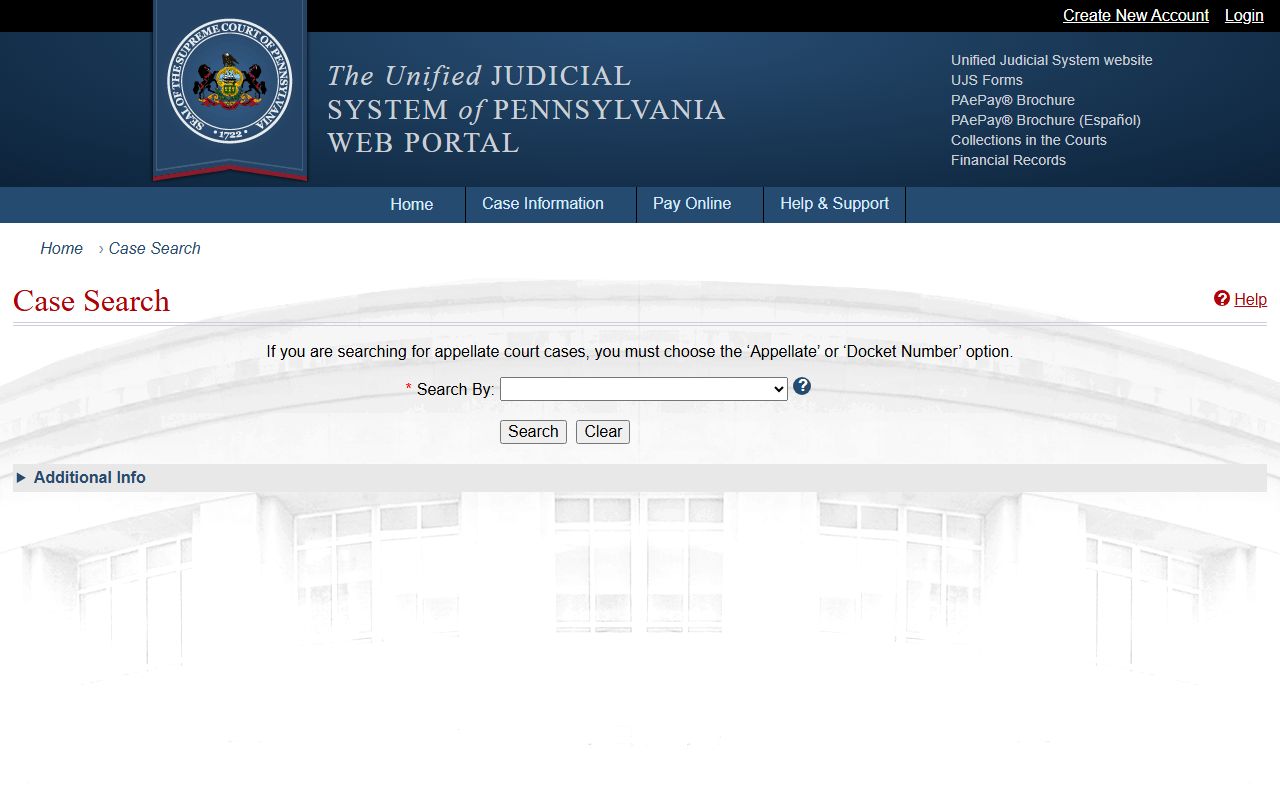
The screenshot supports the main workflow: search the court docket for charges and events, then compare that docket against the PDP custody result.
Philadelphia Arrest to Court Record
The practical sequence is arrest, police processing, custody decision, PDP intake if the person is held, then Municipal Court processing. Charges may appear first in Municipal Court. If the matter is a felony and proceeds, the Common Pleas docket may follow. A reader should avoid treating the first jail record as the full case record because the charge list can change after prosecutor review.
- Confirm custody and facility through the PDP locator or the Classification phone line if the person may still be in jail.
- Open UJS Case Search and search by participant name with Philadelphia County, or use a docket number, complaint number, incident number, or OTN if known.
- Look for an MC-51 docket first when the arrest is recent because Philadelphia Municipal Court initially processes criminal arrests.
- Open the docket sheet and review the charges, bail entries, scheduled events, and disposition fields.
- Check the cross-court docket number field for a related CP-51 Common Pleas case, especially when felony charges continue beyond preliminary proceedings.
Philadelphia Charging Document Records
A court record after an arrest is built from charging documents and docket activity. The complaint is often the first formal charge document. An information may be filed by prosecutors after preliminary proceedings in many felony cases. An indictment is a grand-jury route and is less common, but it can appear in serious matters. The charging document is an accusation. It is not the same as a conviction.
| Document | Who Uses It | What It Means | Philadelphia Context |
|---|---|---|---|
| Complaint | Police or prosecution process | Initial formal allegation starting the case record. | Often tied to Municipal Court processing after arrest. |
| Information | District Attorney | Formal prosecutor charging document after early proceedings. | Common in felony cases that move toward Common Pleas. |
| Indictment | Grand jury route | Grand-jury charge document for certain matters. | Possible but less routine than complaint and information practice. |
Philadelphia Charge Status Records
Charge status can change as the District Attorney reviews facts, witnesses, evidence, plea discussions, and court rulings. A booking label or early complaint may not match the final case outcome. UJS docket sheets are the better place to track whether a charge is still pending, has been changed, has been dismissed, or ended by a prosecutor's decision not to proceed.
| Status | What It Means | Why It Matters |
|---|---|---|
| Pending | The charge or case is not resolved. | Future court events, bail status, and custody may still change. |
| Amended / Reduced | The charge was changed by prosecutor or court action. | The final charge level may differ from the arrest-stage allegation. |
| Dismissed | The charge ended without conviction. | It may still appear unless sealed, expunged, or subject to limited access. |
| Nolle prosequi | The prosecutor does not proceed on that charge. | It is not a conviction, but the docket history may remain visible. |
| Disposition | Current or final outcome for a charge or case. | Read each count because one case may have mixed outcomes. |
District Attorney Court Records
The Philadelphia District Attorney's Office is the prosecuting agency that decides how charges proceed after arrest. PDP does not decide what charges go forward. The DA's office reviews matters, handles prosecution, and maintains its own Right-to-Know process for DA records. The office directory describes divisions and units, including prosecution and conviction-review functions.
For court records after a jail arrest, this means three offices may have different records. PDP has custody and facility data. UJS has docket data. The District Attorney may hold prosecutorial records. A public-records request should be sent to the office that actually owns the record, and investigative or privileged material may be withheld or redacted under Pennsylvania law.
The DA leadership source identifies the Philadelphia prosecuting office connected to post-arrest court records.

The DA role explains why charge records may not match the first booking details shown or discussed right after arrest.
Philadelphia Bail Court Records
Bail is a court function. The official UJS PAePay Bail portal allows electronic bail payments on eligible Pennsylvania cases and supports searches by docket number or participant name. It accepts major cards where electronic bail is available. Research captured a maximum electronic bail card charge of $20,000 per transaction and a 2.75% non-refundable service fee. The portal warns that online payment may not be available for all counties or docket types.
| PAePay Bail Field | Use | Notes |
|---|---|---|
| Search By | Docket number or participant name | Choose the route that matches the known case data. |
| Court Type | Common Pleas, Philadelphia Municipal, or Magisterial District | Philadelphia arrests commonly require Municipal Court review first. |
| County | Participating county selector | Philadelphia is listed among participating counties. |
| Prisoner Number | Optional identifier field | Do not assume it replaces the PDP PID field. |
| Filed Dates | Start and end range | Useful when searching around an arrest date. |
Payment alone may not release a person. A probation detainer, other hold, denied bail, revoked bail, federal hold, ICE matter, paperwork issue, or court order can keep someone in custody. The May 2026 population report also notes that for people in a pretrial non-murder, no-detainer category with active cash bail, 10% of total active cash bail on all open cases may have to be posted for release.
Warrants and Detainer Records
No single official Philadelphia sheriff jail-roster warrant search was located in the research. A warrant can lead to arrest and booking, but the PDP locator confirms custody only after the person is in the jail system. UJS dockets may show bench-warrant events, bail revocation, scheduled hearings, or case dispositions. A probation detainer can keep a person in custody even when bail is posted on a new case.
Neutral next steps are to check the court docket, contact defense counsel or the issuing court, and understand whether a hearing, surrender, bail action, or attorney appearance is required. A person should not rely on a jail roster to clear a warrant. If the person is already in PDP custody, Classification can help with location while the court docket explains case status.
Charges Convictions Sealed Expunged
A Philadelphia County court record after arrest may remain public even when a charge does not become a conviction. Limited-access, juvenile, expunged, and some sealed records may not display in UJS. Title 42 Judicial Code provisions, court rules, and case-specific orders affect sealing and expungement. The public docket should be read with those limits in mind.
| Record Type | Meaning | Public Record Effect |
|---|---|---|
| Charge | An accusation filed in court. | May appear while pending or after disposition unless restricted. |
| Conviction | A guilty plea, verdict, or other conviction outcome. | Often remains visible unless later relief changes access. |
| Sealed / limited access | Hidden from broad public access but not always erased. | Certain agencies may retain limited access. |
| Expunged | Record-clearing relief that treats eligible records as removed under court process. | Public access may end, but eligibility and effect depend on law and order. |
Important: UJS docket data is useful for public case lookup, but it is not a substitute for a certified criminal-history check.
Philadelphia Court Record Access Limits
Pennsylvania's Right-to-Know Law creates a public-records framework, but exemptions still matter. CHRIA governs criminal history record information. Title 42 supplies court, sentencing, sealing, and expungement context. Criminal investigative records, juvenile records, sealed records, limited-access records, and privileged prosecution material may be unavailable or redacted.
For formal requests outside UJS, use the City open-records route for city agency records or the DA Right-to-Know page for DA records. A good request includes the person's name, docket number if known, date range, agency, and a specific description of the record sought. Philadelphia's city RTKL policy requires the statewide form for formal written requests and provides an initial five-business-day response period, with a possible lawful extension up to 30 calendar days.